Planning an office furniture project? Here’s what to think about before you spend anything
Most office furniture projects don’t go wrong because of bad taste. They go wrong because the right questions weren’t asked early enough.
A specification gets agreed, an order gets placed, and it’s only when the furniture arrives or worse, once people have been using it for a few months – that the gaps become obvious. The meeting room table that’s slightly too big. The workstations that don’t account for the monitors your team actually uses. The breakout area that looked great on the floor plan and gets walked past every day.
These aren’t inevitable. They’re the result of a process that started with the wrong things.
Get clear on how your people actually work before you think about furniture
The single most useful thing you can do before any furniture conversation is spend time understanding how your team uses the office, not how you assume they use it, but how they actually do.
Which spaces get used most? Where do people gravitate for focused work versus collaboration? Are there areas that consistently get avoided, and if so, why? What does a typical working day look like for different parts of the team?
The answers to these questions should be the foundation of any furniture brief. A space that looks considered and works well for the people in it is almost always one where someone took the time to understand the reality of how it would be used before a single piece was specified.
Think in zones, not just headcount
A common mistake is approaching a furniture project as a numbers exercise – how many desks, how many chairs, how many meeting room seats. Headcount matters, but it’s the starting point, not the brief.
The more useful question is what different kinds of work need to happen in the space, and whether the environment supports each of them. Focused individual work needs something different from collaborative team sessions, which need something different again from informal conversation and the kind of social interaction that builds culture.
Offices that work well tend to have a clear logic to how their zones are set up – each one designed for its purpose rather than furnished with variations of the same thing throughout. Getting to that logic requires a conversation about how the business works, not just how many people need somewhere to sit.
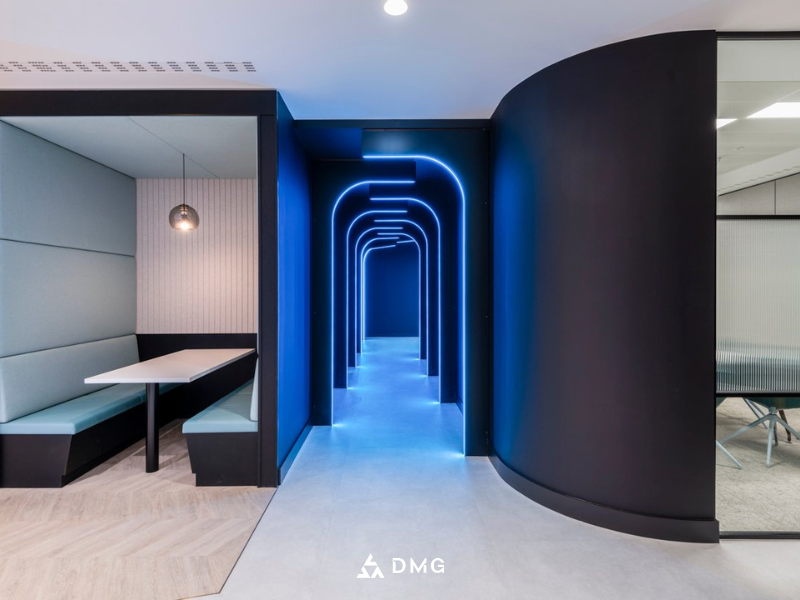 DMG Workplace at Sumitomo’s London headquarters — designed and built by our team as a complete workplace experience.
Know when bespoke is worth it and when it isn’t
Not every project needs bespoke furniture, and not every space is well served by a standard commercial range. Part of getting the brief right is being honest about which approach fits the project.
Off-the-shelf commercial furniture, well specified and well installed, is often exactly the right answer, particularly where budget, timeline or the nature of the space makes it the sensible choice. Bespoke becomes the right conversation when the dimensions, the aesthetic vision or the specific function of a space means nothing available off the shelf will quite do it justice.
The businesses that end up happiest with their furniture years down the line are the ones who had this conversation early, before the budget was fixed and before anyone had fallen in love with a particular product.
Don’t underestimate installation
Even well-chosen furniture can underdeliver if the installation isn’t handled properly. The arrangement of pieces within a space, the flow between zones, the relationship between furniture and light, these details matter, and they’re not always accounted for when a procurement team places an order and waits for a delivery.
A furniture project handled end-to-end, from brief through to installation, tends to land differently to one where the specification and the delivery are treated as separate exercises. The difference shows up in how the space feels once people are actually using it.
How DMG Furniture can help
This is exactly the kind of conversation we have with clients at the start of every project. We work with businesses across the UK to specify, source and install commercial furniture – from individual pieces to complete office schemes – and every project starts with understanding the space and the people in it before anything gets ordered.
Whether it’s a full refurbishment, a specific area that needs rethinking, or a bespoke piece that needs to do something no standard option can, we manage the process from first conversation to final installation.
If you’re at the early stages of a furniture project and want to think it through properly, we’re always happy to start there.
Talk to the DMG Furniture team
